Using git for scientific software projects, February 15th

During workshop we will cover all the basic elements of how the code is nowadays managed using the open infrastructure provided by GitHub and the free CI runners. You will learn how to set up a repository so that others can contribute to it by sending pull requests, and to have the pull requests automatically tested.
Plan of the workshop:

– quick introduction to version control using git
– testing scientific code and using CI systems
– the OSS workflow using public code, branches, pull requests, and review

Please find the application form here. We wait for applications until February 11th.

Tutor:

Zbigniew Jędrzejewski-Szmek has a PhD in molecular physics and experience with development of both scientific and non-scientific open-source software. After 10 years of working as a scientist and a scientific programmer, he is currently working for Red Hat.

Introduction to Software Engineering for Scientists, February 25-26th

The aim of the workshop is to improve coding skills of its participants to include software engineering techniques. Participants will learn a new way of thinking about their code, as well as some useful techniques and tips. After the workshop, the participant will be able to write more reliable, readable and reusable code, and in consequence to make their research more reproducible. The workshop IS NOT intended as a course of any particular software development tool though. 

Day 1 (4-5h of lectures): 

  •     programming paradigms (OOP, structured and functional),
  •     good programming practices,
  •     SOLID principles.

Day 2 (~1h of programming exersises, ~3-4h of lectures): 

  •     Test Driven Development,
  •     Mocking,
  •     Tutorial Driven Documentation (optional)

Requirements: 

  •     intermediate proficiency in programming (Python recommended),
  •     a device with Anaconda Python installed (2nd day),
  •     Polish proficiency may make your 2nd day experience funnier;-).

Please find the application form here. We wait for applications until February 20th.

Tutor

IMG_0187-US Wiza (format cyfrowy)-900x900 px.jpgJakub Dzik is a scientific programmer working in the laboratory of Neuroinformatics, Nencki Institute, where he is developing software tools for scientific use. Striving to improve research reproducibility by delivering code that is reliable and easy to manage, I have learned the basics of software engineering.
3D printing workshop, January 26th

We have a pleasure to announce our next workshop on 3D printing!

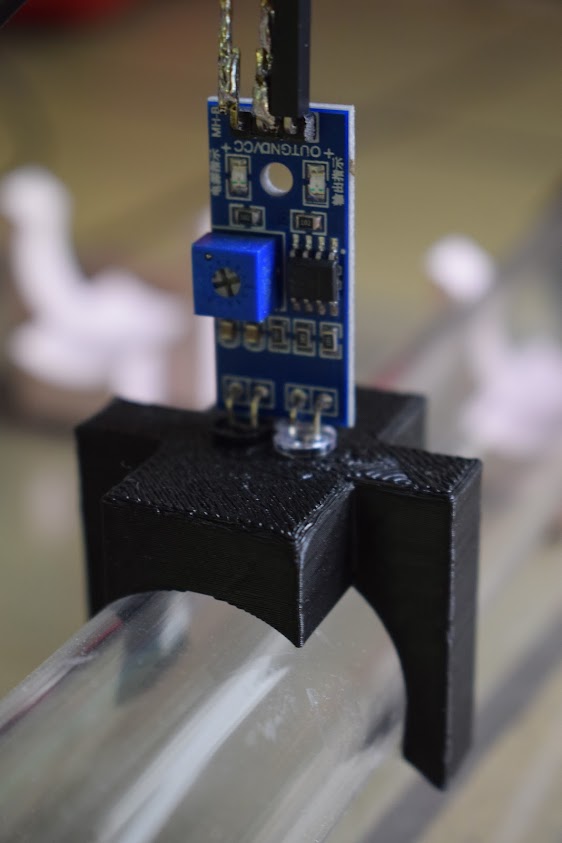
Additive manufacturing, commonly known as 3D printing is a rapidly developing subfield of fabrication. Unprecedented versatility and constant decrease of prices of both the software and the hardware contribute to the growing popularity of 3D printing. Ability to create and at hand manufacture almost any objects needed may greatly improve capacity and cost-effectiveness of development of highly customised experimental setups. We would like to present the possibilities and limitations of the academic applications of 3D printing.


During the workshop participants will be acquainted with an overview of 3D printing technologies, construction of FDM printers and workflow of design, printing and postprocessing of desired objects.

 Please find the application form here. We are waiting for the applications till January  13th.

Contact: m.kostecki@nencki.gov.pl

Deep Lab Cut Workshop, December 13-14th

deeplab
Photo from http://www.mousemotorlab.org/deeplabcut/


We would like to invite you to the workshop about Deep Lab Cut Software with dr Alexander Mathis (Bernstein Centre for Computational Neuroscience, Tuebingen, Harvard University).

 Deep Lab Cut is an open-source software based on transfer learning with deep neural networks, allowing very precise and efficient tracking of the body parts of the animal (from Drosophila to human). It can be used to track e.g. single whiskers of the mouse, body parts of the rat in the open maze test, human hand movements and more.

Tracking of the electric fish body parts (by Avner Wallach) and human hand movements (by James Bonajuto)


More about the software can be found here . 

Participation in the workshop is free. Basic knowledge of Python is required. Please find the application form hereWe are waiting for the applications till November 29th.

Contact: m.kostecki@nencki.gov.pl


Teaching Assistants:

 Alexander Mathis

Is a postodoctoral fellow in the lab of Matthias Bethge at the Bernstein Center for Computational Neuroscience in Tuebingen and the University of Tuebingen and the lab of Venkatesh N. Murthy at the Department of Molecular and Cellular Biology at Harvard University. He is interested in in odor-guided navigation, pose estimation as well as motor control and adaptation.

Bonsai Workshop

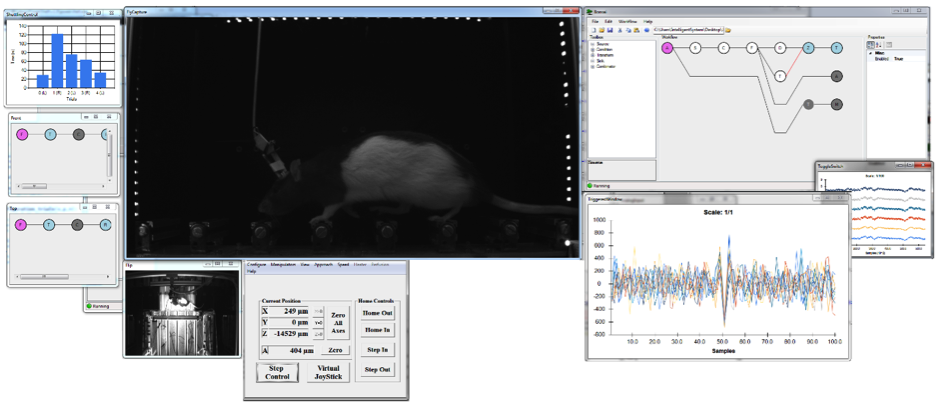
bonsai

We would like to invite you to the first workshop about Bonsai programming language with Nacho Sanguinetti from Bernstein Centre for Computational Neuroscience

Bonsai is an open visual programming language used in neuroscience for the development of behavioural paradigms. You can use Bonsai to track an animal, deliver visual or auditory stimuli and combine it with Arduino to control lasers, automated doors, synchronize different setups – and many, many more. 

More about Bonsai can be found here.

The aim of the workshop will be to develop a closed – loop behavioural paradigm, in which animal will be tracked online and the cage environment will change – the door will open, the light will be switched and the sound produced depending on animal’s position and behaviour.             You will learn also the basics of Arduino programming. During the last day of the project, you will be also able to discuss your ideas and ask us how to implement skills from the workshop in your everyday research practice.              We also plan an integration session on Tuesday, November 22nd!

 
Please find a registration form here .

Contact: nenckiopenlab@gmail.com

The workshop will take place 10AM – 2PM each day in the Department of Physics, Warsaw University. 


 Juan Ignacio Sanguinetti 

(Bernstein Center for Computational Neuroscience, Berlin) has graduated from University of the Republic, Montevideo (Uruguay) has strong background in behavioural studies, including work on electric fish and mice. Currently he works as a post-doc in the lab of Michael Brecht in Bernstein Center for Computational Neuroscience, Berlin. He combines behavioural techniques with in vivo electrophysiological recordings.