
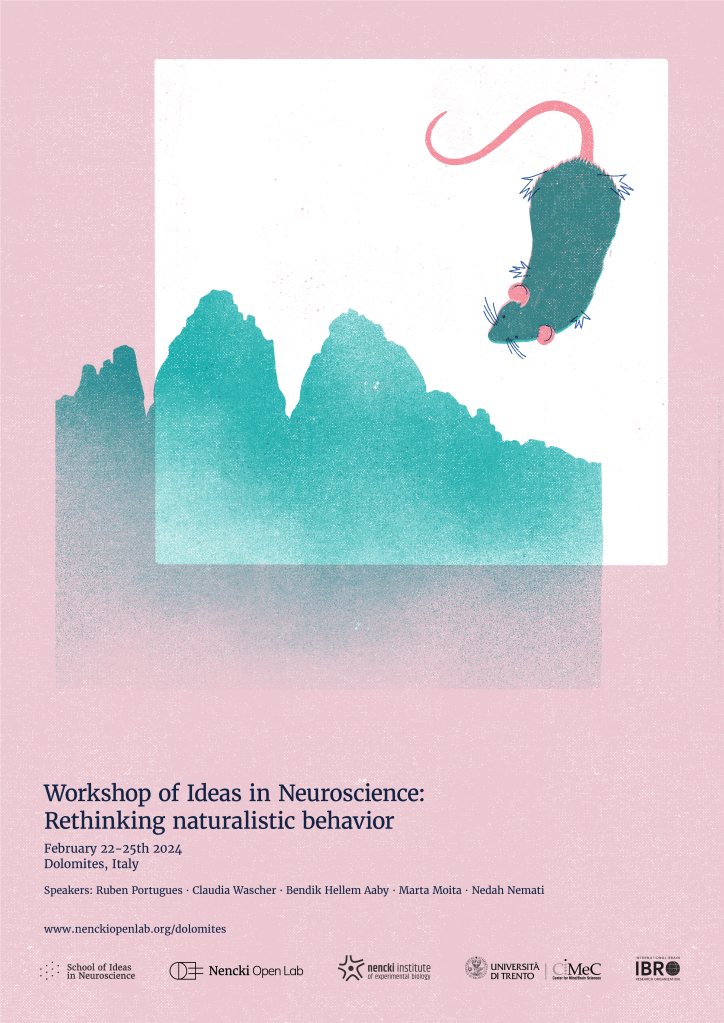
Workshop of Ideas in Neuroscience:
Rethinking naturalistic behavior
Dolomites, Italy, Feb 22 – 25 2024
A specter is haunting neuroscience – the specter of behavioral revolution.
For years treated as a nuisance, the source of noise or – at best – a simple, measurable readout of what is happening in the brain, behavior is finally becoming the center of interest in systems neuroscience.
But neuroscience not only realized that it needs behavior: it also became obvious that behavior is something more than a head-fixed mouse watching black bars on the screen or a rat running in an empty plexi open field. The behavioral repertoires of animals are much richer; they evolved as an adaptation to their peculiar environmental niches and may not be best expressed in sterile laboratory conditions. The activity of a head-fixed mouse may be far different from what is happening in nature.
Hence the recent turn towards naturalistic behaviors. Many systems neuroscientists are now designing their behavioral paradigms to match the natural environments of the animals they study: they broaden the space animal can use, make it more complex, or even go to the field. „Naturalistic” or „ethologically relevant” behaviors became buzzwords, and there is no worse offense than calling your paradigm „unnatural”.
As good and refreshing revolutions in science are, there is always a time when it is good to stop and think. We think it is the time to rethink naturalistic behaviors in neuroscience.
What is really natural? What do we know about the ecological niches of our mice, rats, or fishes? Does every study need to be ethologically relevant? What really do we lose when we head-fix our mouse? Can we really categorize brain activity as natural or unnatural?
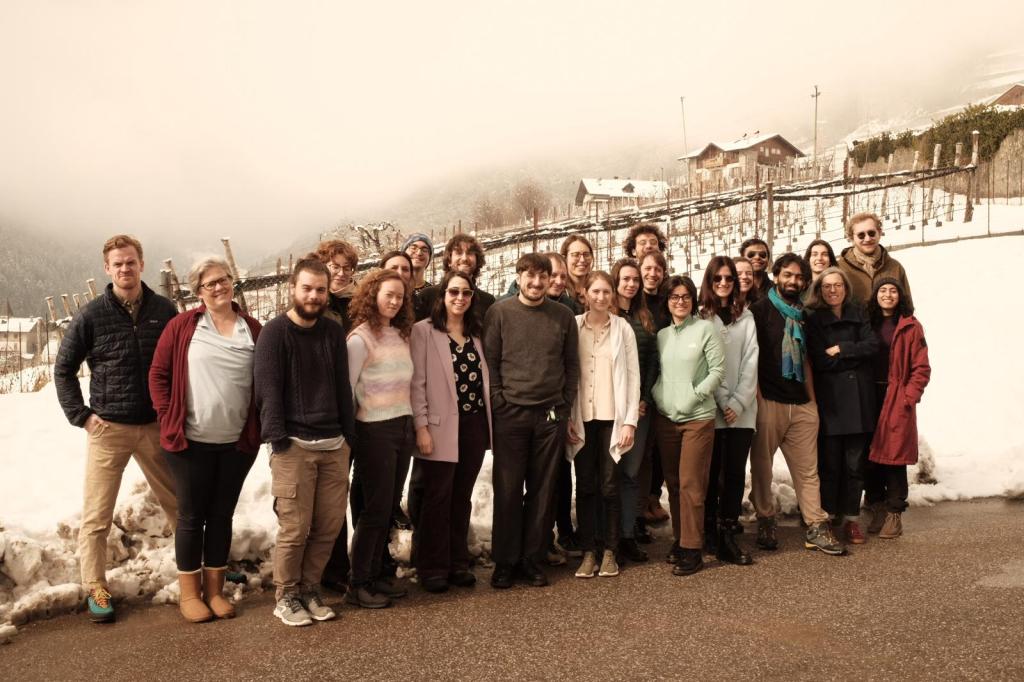
We have pondered those questions during our first Workshop of Ideas in Neuroscience. Our workshop wasorganized in the spirit of our School of Ideas – with beautiful surroundings, long talks, small groups, a relaxed atmosphere, and a lot of time to think!
Guests
- Ruben Portugues (Technical University of Munich)
- Claudia Wascher (Anglia Ruskin University)
- Bendik Hellem Aaby (University of Oslo)
- Marta Moita (Champalimaud Centre for the Unknown)
- Nedah Nemati (Columbią University)
Organizers
- Luigi Petrucco (Istituto Italiano di Tecnologia)
- Matilde Perrino (University of Trento)
- Natalia Krasilshchikova (Universität Bonn)
- Anna Chrzanowska (NERF)
- Mateusz Kostecki (Nencki Institute)
The workshop was funded by International Brain Organization
 Nencki Open Lab